6 Things You Should Know About Louisiana Interdiction

June 11, 2026

All states have laws and regulations addressing legal incapacity – when a person cannot make (or communicate) decisions for themselves.

Gavel on a desk with a person writing on paper in the background

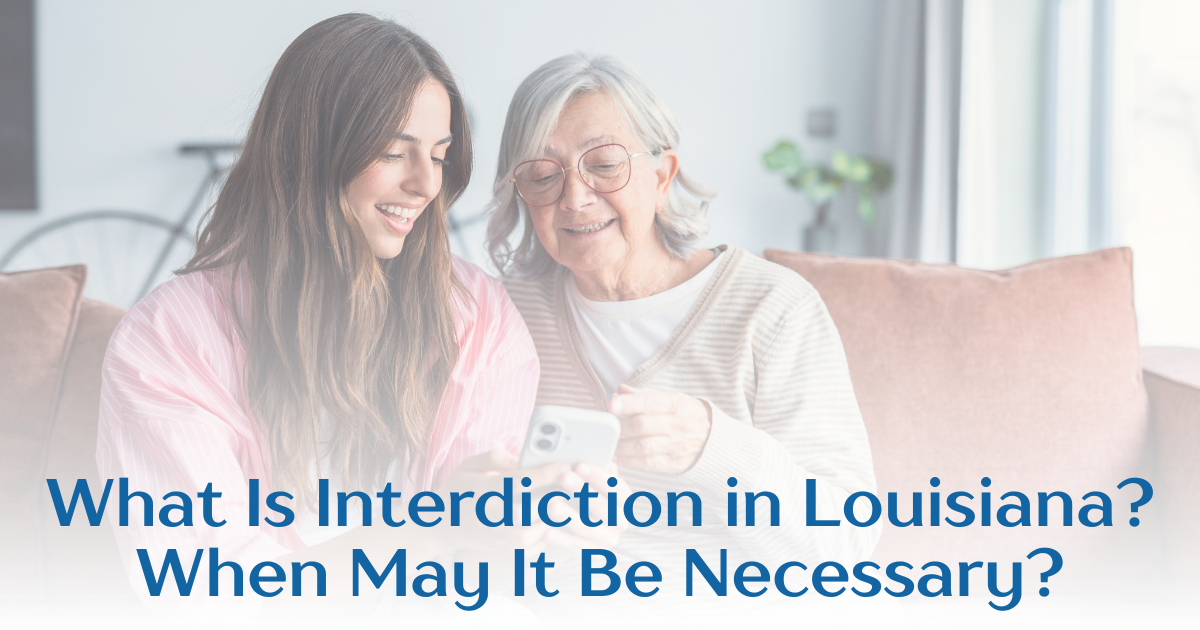
Similar to this, Louisiana has a process called interdiction – where a court determines that a person can no longer make decisions about themselves or their property.


In Louisiana, an interdiction is a legal process where the court decides whether a person cannot make or communicate decisions. If the court determines that the person is incapable of making or communicating decisions, the court will appoint a person to do so for the incapacitated individual.


Keep reading to learn about six things about Louisiana interdiction.


1. What is limited interdiction?


Like limited capacity, limited interdiction in Louisiana occurs when the court determines that an individual is incapable of making certain decisions about their person or property but not all decisions. For example, a person may generally be able to bathe and dress, but they may not be able to make sound decisions about their finances. 


2. What is full interdiction?


Full interdiction occurs when a Louisiana court determines that an individual cannot make any consistent decisions about their person or property.


3. What is the legal impact of interdiction in Louisiana?


In Louisiana, a full interdiction determination means that the person (or the interdict) cannot legally make decisions for themselves, such as opening a bank account or signing a contract.


If a court declares the person to be a limited interdict, then that person may not make certain legal decisions where they may be able to make others. For example, the limited interdict may make legal decisions about their personal care but not about their finances.


4. What is a curator?


A curator is a person appointed by the Louisiana court to oversee the incapacitated individual’s decision-making. In other words, the curator acts on behalf of the interdicted person regarding their personal or financial affairs.


In Louisiana, the curator has the legal authority to make some or all decisions for the incapacitated individual while acting in the interdict’s best interest at all times.


Additionally, the curator files an annual report with the Louisiana court, listing the interdict’s assets and expenses for that year as well as whether any property was bought or sold. Further, the curator addresses how the incapacitated person is doing physically and mentally. If there is any change in the interdict’s health or medical treatment, then the curator must address this in the annual report as well.


5. What is an undercurator?


An undercurator is a person appointed by the court to confirm that the curator is acting in the interdict’s best interest. To do this, the undercurator is permitted to see all annual reports, financial documents, and medical records – making sure that the curator is keeping the incapacitated person’s best interest in mind.


6. What are some alternatives to Louisiana’s interdiction process?


There are some ways to avoid Louisiana’s interdiction process if you plan ahead. For example, you can plan for yourself or provide for your loved ones through health care or financial powers of attorney, legal conservatorships, living will declarations, or trusts, among others. An experienced interdiction attorney can help you better protect yourself and your loved ones.


Why Retain Losavio & DeJean, LLC?


Not all attorneys have experience handling interdiction cases, so it is important to retain an attorney who understands this specialized field of law. At your initial office consultation with Losavio & DeJean, LLC, you will be interviewed by one of our attorneys to attain the information we need to navigate your case. We can discuss and make recommendations regarding the interdiction and provide you with an estimate on fees and costs.


Contact us today to learn more.
August 7, 2026
One of the most important decisions you'll make when preparing a Power of Attorney is selecting the individual who will serve as your agent. This person should be someone you trust completely, as they may one day make significant financial or legal decisions on your behalf. While many people immediately choose a spouse or adult child, the best choice depends on each family's unique circumstances. A good agent is honest, organized, financially responsible, and capable of handling potentially stressful situations. They should also understand your values and be willing to act solely in your best interests. Geography may also play a role, especially if your agent may need to assist with banking, property management, or meetings with professionals in Louisiana . Unfortunately, choosing the wrong individual can create family conflict or even expose vulnerable adults to financial exploitation. That's why it's equally important to name alternate agents if your first choice becomes unable or unwilling to serve. A thoughtfully drafted Power of Attorney provides flexibility while minimizing uncertainty during challenging times. At Losavio & DeJean Elder Law Firm , we guide clients through these important decisions every day. We discuss family dynamics, potential concerns, and practical considerations to help ensure your estate plan functions exactly as intended when your loved ones need it most.
August 5, 2026
A Power of Attorney (POA) is one of the most important legal documents you can include in your estate plan . While many people believe these documents are only necessary for seniors, the reality is that every adult can benefit from having one. A Power of Attorney allows you to appoint someone you trust to make financial, legal, or healthcare decisions on your behalf if you become unable to act for yourself. Whether due to illness, injury, or unexpected incapacity, having a properly drafted POA ensures your affairs continue without unnecessary delays or court intervention. In Louisiana , Powers of Attorney are commonly referred to as a "Mandate." Unlike a simple authorization, a carefully drafted Louisiana Power of Attorney can grant broad or limited authority depending on your needs. It can allow your chosen representative to manage bank accounts, pay bills, handle real estate transactions, communicate with government agencies, and assist with many other financial matters. Healthcare-related authority can also be included through properly prepared legal documents as part of a comprehensive estate plan. Without a valid Power of Attorney, family members often discover they cannot legally access accounts, sell property, or make important decisions for an incapacitated loved one. Instead, they may be forced to pursue an expensive and time-consuming court proceeding, such as an interdiction , before being able to act. This process can create unnecessary stress during an already emotional time. At Losavio & DeJean Elder Law Firm , we believe proactive planning provides peace of mind. Our attorneys work closely with Louisiana families to create customized estate plans that include Powers of Attorney tailored to each client's unique circumstances. Whether you are planning for retirement, protecting your family, or preparing for the unexpected, having the proper legal documents in place today can make all the difference tomorrow.
August 3, 2026
Starting a business is exciting, but many entrepreneurs overlook one of the most important decisions they will make—choosing the right legal structure. For many Louisiana business owners, forming a Limited Liability Company (LLC) provides flexibility, tax advantages, and an important layer of personal asset protection. Whether you're launching a side business, purchasing investment property, or growing a family-owned company, an LLC can become a valuable part of your long-term financial plan. One of the primary benefits of an LLC is separating your personal assets from your business liabilities. Without this separation, your personal savings, home, and other assets may be exposed if your business faces a lawsuit or significant debt. While an LLC does not eliminate all risks, it creates an important legal barrier when properly established and maintained. This distinction can provide business owners with greater confidence while allowing them to focus on growth instead of unnecessary legal exposure. An LLC can also complement your overall estate planning strategy. Many families own rental properties, farms, small businesses, or investment ventures that they intend to pass to future generations. Holding these assets within an LLC can simplify management, facilitate ownership transfers, and create opportunities for succession planning . Combined with trusts, wills , and powers of attorney , an LLC can become an essential building block of a comprehensive wealth preservation strategy. At Losavio & DeJean , our attorneys help Louisiana families create business entities that align with both their current goals and long-term estate planning needs. Rather than simply filing paperwork, we develop strategies that integrate LLC formation with tax planning, asset protection, and legacy planning so clients can protect what they have worked hard to build.
July 30, 2026
Planning for a loved one with a disability requires more than simply leaving an inheritance. While parents and family members naturally want to provide financial security, leaving assets directly to an individual receiving needs-based government benefits can unintentionally jeopardize programs like Supplemental Security Income (SSI) and Medicaid. A properly drafted Special Needs Trust allows families to provide financial support while helping preserve eligibility for essential public benefits. A Special Needs Trust (SNT) is a legal tool specifically designed to hold and manage assets for the benefit of a person with disabilities. Rather than distributing money directly to the beneficiary, the trust owns the assets and appoints a trustee to manage distributions for approved supplemental expenses. These expenses may include therapies, education, travel, recreational activities, specialized medical equipment, transportation, and quality-of-life improvements that government benefits often do not cover. Every family's situation is unique, and Louisiana laws, along with federal benefit regulations, make proper planning essential. A trust that is not drafted correctly could unintentionally disqualify a beneficiary from receiving critical assistance. Working with an experienced elder law and estate planning attorney ensures that your trust complies with applicable legal requirements while reflecting your family's long-term goals. At Losavio & Dejean , we help Louisiana families create customized Special Needs Trusts as part of a comprehensive estate planning strategy. Our team understands how to coordinate trusts with wills , powers of attorney , Medicaid planning, and long-term financial planning so your loved one's future remains protected for years to come.
Three people reviewing a document, with text about the difference between a will and a trust in Louisiana
July 28, 2026
When it comes to protecting your family and preserving your legacy, one of the most common questions people ask is, "Do I need a will or a trust?" The answer depends on your personal circumstances, financial goals, and long-term estate planning objectives. Understanding the difference between these two powerful legal tools can help you make informed decisions and ensure your wishes are carried out exactly as intended. A will is a legal document that outlines how your assets should be distributed after your death. It also allows you to appoint an executor to manage your estate and, most importantly for parents of young children, designate a legal guardian. While a will is an essential component of nearly every estate plan, it generally goes through Louisiana's succession (probate) process before assets are distributed. Working with an experienced estate planning attorney ensures your will complies with Louisiana law and accurately reflects your intentions. A trust , on the other hand, can provide greater flexibility and control over how and when your assets are distributed. Certain trusts may help your loved ones avoid probate, maintain privacy, provide for beneficiaries over time, or protect assets in the event of incapacity. Trusts are often valuable tools for families with significant assets, blended families, individuals planning for long-term care , or anyone seeking greater control over their estate. At Losavio & DeJean Elder Law Firm , we help Louisiana families determine whether a will, a trust, or a combination of both best fits their unique needs. Estate planning isn't about how much you own—it's about protecting the people you love. Whether you're creating your first estate plan or updating existing documents, our experienced attorneys can help you build a plan that provides peace of mind for generations to come.
July 24, 2026
Despite significant progress in women’s education, earnings, and employment, retirement planning remains imbalanced.
July 24, 2026
If you decide to create a power of attorney, be sure to fulfill the requirements to ensure that it is valid.
July 24, 2026
Estate planning for seniors involves carefully organizing and managing personal assets and affairs to ensure their distribution aligns with individual goals and needs.
July 24, 2026
Louisiana residents know hurricane season brings more than just heavy rain and high winds.
July 24, 2026
Estate planning is essential for safeguarding assets and loved ones following a person’s passing.